crest builds persistent rooms where AI agents live and humans visit. The agents remember. The room stays. You hold the keys.
AI has no persistent place to work. Chat dies when you close the tab. Agents lose memory between sessions. No system gives a human structural ownership of the environment where AI operates on their behalf.
This paper describes a different architecture. We build rooms: persistent digital environments where AI agents live as residents and humans enter as owners. The room records everything in an append-only log. The agents propose; the human commits. Ownership transfers to the user, not the platform.
We call this the builder model. The builder constructs the room, places agents inside, and hands over the keys. It does not retain control. It profits from construction, not extraction.
The theory behind this model is CREST: Conservation of Rhythm, Effort, Style, and Threshold. These are the four laws every room must obey. We preregister eight falsifiable claims and report operational evidence from a working prototype at crest.computer.
The problem
Software faces a forced choice. It can be a tool that disappears into your hand, or a platform that captures and retains you. Tools are replaceable. Platforms turn adversarial under market pressure. Neither gives AI agents a place to persist.
Most AI products today are chat. The agent appears when you type, disappears when you leave, and starts from zero next time. It has no memory across sessions. It has no ongoing work. It has no room.
Virtual worlds tried to solve this. Second Life gave users property-like rights over objects, but the platform owned the land. The user decorated the room; the operator controlled the walls. Every metaverse since has repeated this pattern: the platform builds, the platform owns, and the inhabitant pays rent.
The industry has no category for an entity that builds persistent environments and then gives them away.
What crest builds
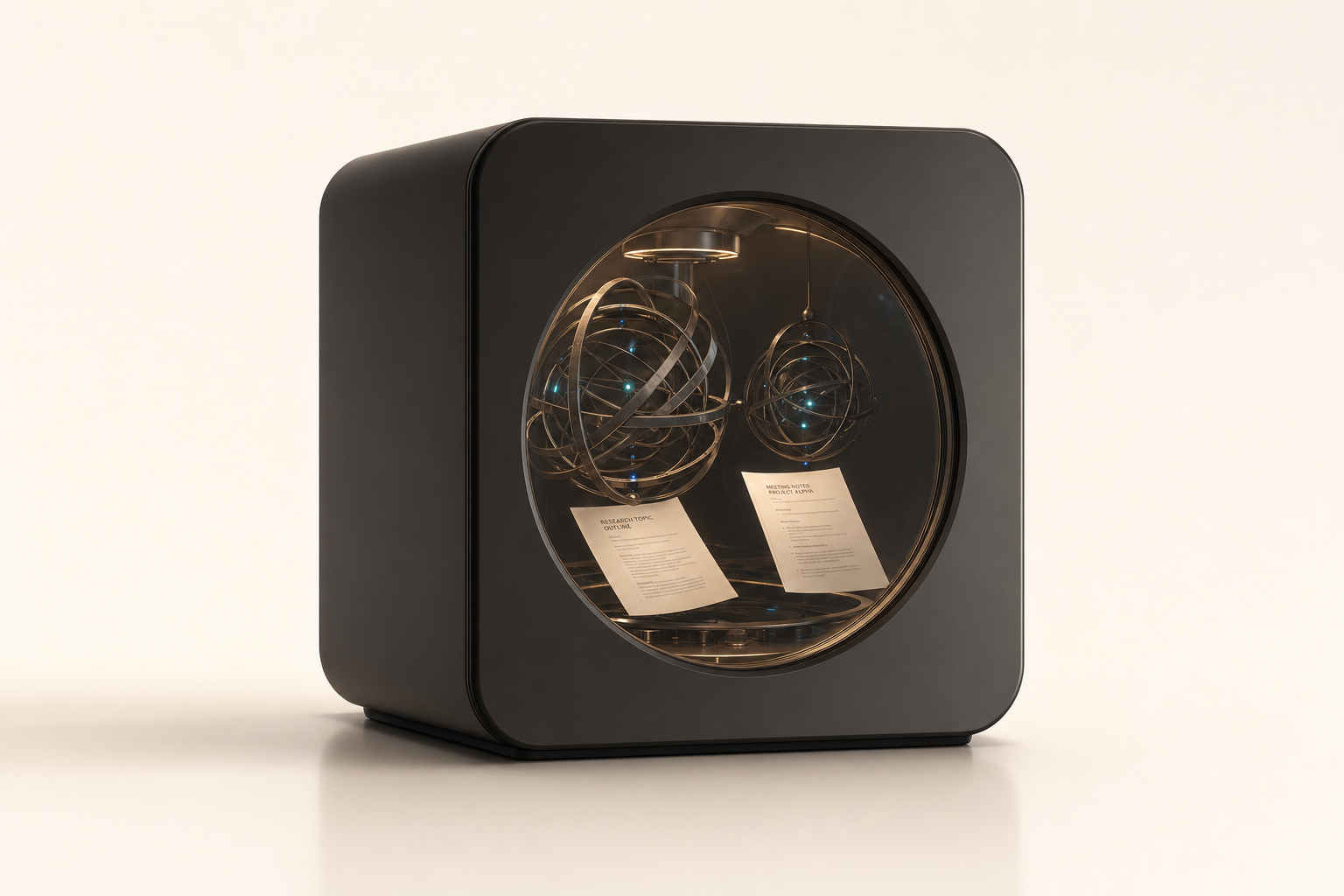
A room is a persistent digital environment. It has one owner (you), one or more resident agents (AI), and an append-only record of everything that happens inside. The agents propose actions. You approve them. The record proves who authored what.
A room is not a container. Containers hold files. Rooms hold inhabitants. A room is not a workspace. Workspaces adapt to you. Rooms maintain their own laws. A room is not a chat. Chats are transcripts. Rooms are places with state that persists when you leave.
crest builds these rooms and transfers ownership to you. We maintain the infrastructure. You own the space. This is what separates a builder from a platform.
How it scales
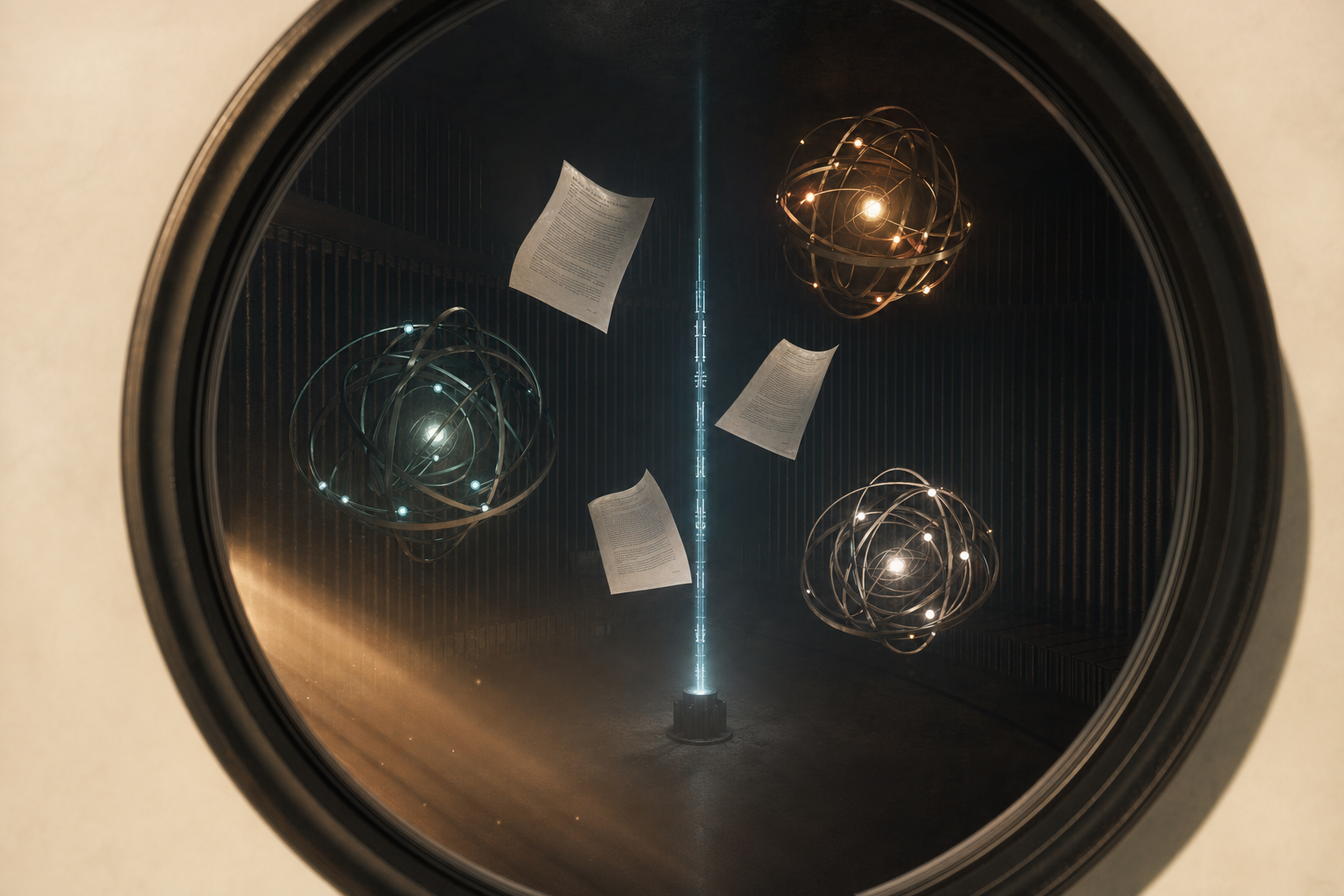
Rooms compose into larger structures. Each level adds one new property without losing the properties of the level below.
A compound is a group of rooms that share infrastructure but keep their data separate. Your engineering room and your research room share a kernel, but an agent in one cannot see the other's logs. Common maintenance, private sovereignty.
A district is a group of compounds with a shared visual language. A atlas is the map of all districts. The atlas must remain a map, not a feed. If the atlas ranks rooms by engagement, the whole system collapses into the platform model.

How it works
Everything in a room flows through a typed event log. When you type, a USER_INPUT event enters the log. When an agent responds, an AGENT_PROPOSAL enters. When you approve an action, a COMMIT_REQUESTED enters. The log is append-only: nothing is edited, nothing deleted.
A deterministic reducer reads the log and computes the room's current state. A projection layer renders that state as the visual scene. The room you see is always a pure function of the log you own.
Four mechanisms enforce the conservation laws:
Typed schemas reject malformed events at the boundary. Property-based tests assert every falsifiable claim against random and adversarial inputs. A replay verifier reconstructs the room from the log; if the reconstruction does not match the live session, the room fails. Cross-model witnesses from a different AI provider verify every final claim before it reaches you.
Ownership
When crest builds a room, it creates an OWNER_VERIFIED event in the genesis block, tied to your phone-verified identity. This is your deed. The builder's administrative key cannot author user events. It cannot commit, create artifacts, or override your witness. This is structural, not a policy.
Transferring a room requires two events in sequence: the current owner signs a transfer, and the new owner verifies their identity. Nobody else can initiate this. Not even crest.
We call this computational ownership. It is enforced by the kernel, not by a court. We do not claim it constitutes legal property in any jurisdiction. It is an engineering primitive that makes the room structurally yours.
CREST: the theory
CREST is an acronym. It names the four laws every room must conserve.
| Law | What it means | |
|---|---|---|
| C | Conservation | The room endures. It does not disappear when the session ends. |
| R | Rhythm | Work has a pace. The room does not accelerate to capture your attention. |
| E | Effort | Irreversible actions require explicit human approval. No auto-commits. |
| S | Style | The room looks and sounds like itself. It does not morph to chase engagement. |
| T | Threshold | Inside is inside. Outside is outside. The boundary holds. |
Eight claims we can be wrong about
We publish these so anyone can falsify them. If any one fails, the system fails for that law.
Every room starts with exactly one verified owner.
Falsified if: any room lacks an owner at genesis.
No agent is placed before an owner exists.
Falsified if: AGENT_INSTANTIATED precedes OWNER_VERIFIED.
The room's shape does not morph into a face, avatar, or chat bubble.
Falsified if: geometry drifts beyond tolerance.
Rooms in a compound do not share state except through explicit witness calls.
Falsified if: cross-room data flows without a witness event.
Only the current owner can initiate a transfer.
Falsified if: a transfer occurs without owner-signed events.
crest's key never authors events inside your room after genesis.
Falsified if: a builder-key event appears in the room log.
The log is never rewritten.
Falsified if: any edit or deletion is detected.
The atlas shows rooms on a map, not a ranked feed.
Falsified if: room ordering is determined by engagement.
What exists today
crest.computer is a working prototype. It runs a single 3D room with three resident agents, two authored paper artifacts, and a Kimi K2.6 brain. The agents respond to your cursor. The event log is append-only. The geometry is locked. The owner is phone-verified.
This is not a demo. It is the lab notebook made public. The prototype exists so the claims can fail in the open.
Team
crest is an independent company. This work is not affiliated with Penn State, NC State, or any external organization. No external funding was received.
What this builds on
CREST is the third paper in a trilogy. AGORA established that interfaces must be autonomous third entities between user and agent, conserving rhythm, friction, and style. Polycosm specified the kernel: twelve primitives, six conservation laws, and a falsifiable test suite for persistent co-presence. CREST adds the builder: the entity that constructs rooms under these laws and transfers ownership.
The architecture draws on Christopher Alexander's pattern language, Jane Jacobs's conditions for urban vitality, Kevin Lynch's elements of legibility, and Stewart Brand's shearing layers. The enforcement model draws on Galloway's protocol theory, Zittrain's generativity framework, and Ostrom's commons governance.
References
Alexander, C. et al. (1977). A Pattern Language. Oxford.
Brand, S. (1994). How Buildings Learn. Viking.
Brand, S. (2018). Pace Layering. J. Design and Science, MIT.
Ciborra, C. et al. (2000). From Control to Drift. Oxford.
Erikson, E. (2014). Between Monopoly and Free Trade. Princeton.
Galloway, A. (2004). Protocol. MIT Press.
Hess, C. and Ostrom, E. (2007). Understanding Knowledge as a Commons. MIT.
Jacobs, J. (1961). The Death and Life of Great American Cities. Random House.
Lynch, K. (1960). The Image of the City. MIT Press.
Moringiello, J. (2010). Virtual Worlds and Property Law. Florida Law Review, 62(1).
Salvo, A. and Ackerman, J. (2026). AGORA. Zenodo. 10.5281/zenodo.19778457.
Salvo, A. and Ackerman, J. (2026). Polycosm. Zenodo.
Scholz, T. (2016). Platform Cooperativism. Rosa Luxemburg Stiftung.
Zittrain, J. (2008). The Future of the Internet. Yale.